Tuesday, April 22, 2014

Shinola CEO hints at possible mechanical watch

A Shinola mechanical watch could soon be a reality, according to Steve Bock, CEO of Shinola, Detroit, makers of quartz watches, bicycles, leather goods, and soon furniture.

In an interview at Baselworld 2014, Bock told me that the pieces to the puzzle are basically in place; it's just a matter of timing (no pun intended), and how a mechanical wristwatch fits into the company's overall vision of being a "design company" and not just a "watch company."

Steve Bock


"Where we will obtain the mechanical components, and how we will retrain our assembly staff will be two big issues," says Bock. "But we have no reason to believe that either will be a stumbling block. With our success so far, we have people knocking at our door to help us in any direction that we wish to go."

Shinola's big news at Baselworld 2014 was the announcement of their new limited lifetime warranty, which goes into effect not only for all new Shinola quartz watches sold, but is retroactive for all watches sold previously. In case of defects, all components (excluding battery, leather strap and buckle)  are covered by the warranty, and will be repaired (or the watch will be replaced) free of charge. If the exact model is not available for replacement, a watch of equal value and similar style will be provided. A copy of the receipt and/or your completed warranty card is required as proof of purchase. A check or money order payable to Shinola/Detroit, LLC in the amount of $25.00 as service and handling fee must be included for all warranty and repair services. The fee is subject to change.
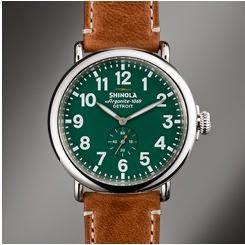
A "Runwell" model from the company's collection.


Shinola says the warranty is unique in the industry, and Bock says it speaks to the confidence not only in the watches themselves, but to the company's confidence of being around for a very long time.

Another issue will be price. Shinola's current entry level price for a quartz timepiece is about $500. While Bock declined to get into specifics, it's a sure bet that a mechanical wristwatch could not be produced at that price level, at least not one of any quality. Currently, the entry price for a man's watch with a Swiss-made automatic mechanical movement is about $1,000.

"It (producing a mechanical watch) is over the horizon, but not that far over the horizon," says Bock. "If you come back and talk to us a year from now, I think we would have a more specific answer for you."

Shinola's next big announcement will be its launch into the furniture business, which will bring back a manufacturing sector long crippled in the USA by migration of that industry to Asia. The move is designed to further enhance Shinola's goal of being known as a "design company," rather than just a watch company, though watch sales currently make up about 85% of Shinola's business, according to Bock.

Look for my complete story on Shinola in the May/June issue of the NAWCC's Watch & Clock Bulletin, out in about a week.

Bye for now,

Bruce

Wednesday, April 2, 2014

"We're All Mad Here ..."

... said the Cheshire Cat to Alice, in the Lewis Carroll classic, when she lamented that she didn't wish to mingle among the crazy. In describing my impressions of the current-day watch market. I have to say I feel a little bit like Alice who fell into the rabbit hole and landed in Wonderland.

I certainly do not wish to bite the hand that, literally, fed me this past week. As an accredited member of the media, I was well cared for by the folks at Baselworld 2014 (BW2014): complimentary admission (worth $165 all by itself); soup, sandwiches and beverages every day for lunch (saving me from a fate of energy bars that I had brought from home to avoid the mafia prices for food by the fair concessioners); and a very nice media center with work stations, Wi-Fi, and restrooms.

But I have to be honest: Prices for new watches are simply ridiculous.

I knew going into BW2014 that prices on new mechanical watches are incredibly higher -- sometimes by a factor of 10 times or more -- than a vintage piece by the same manufacturers.  I gladly concede that some of this is due to better materials (both movements and cases), and just plain old inflation. A nice Omega Seamaster in stainless steel that cost $145 in the year 1955 would be roughly equivalent to $1,266 in 2014.

But try to find an Omega Seamaster in the 2014 catalog for anywhere near that price. The most basic stainless steel Seamaster with an automatic movement and a leather strap will run you about $5,400 at full manufacturer's suggested retail price (MSRP).

And the reason for that became abundantly clear at BW2014:

Marketing.

I have no way to prove this, but I feel fairly certain that once upon a time in the not too distant past (let's say the 1950s) that marketing/advertising made up 10 or maybe 15% of a watch's retail price. Today, that percentage is 50% or better for the vast majority of the brands (with a few exceptions), and I challenge anyone to prove me wrong. An industry insider at BW2014 told me, off the record, that it's not unusual for a watch company to take their total cost of the actual material that goes into a watch, and multiply that by a factor of eight or even 10 to arrive at MSRP.

Modern watch marketing is filled with components that company founders and their second- and even third-generation heirs could not possibly have imagined ... celebrity endorsers, high profile (and high cost) sports sponsorships, movie tie-ins, and image advertising in high priced luxury magazines. One watch company, Jacques Lemans (which I have never heard of, by the way), is using Kevin Costner as its celebrity endorser.

Kevin frickin' Costner.

I mean, c'mon Kevin. You're a likable enough guy. Loved you in "Dances With Wolves," and "Tin Cup," among other movies. But for Christ's sake, stick to what you know, will you? Did you really need a quarter million dollars (or whatever they gave you) and a free watch?

So I really don't know where this is all headed, but I'm of the firm belief that the Swiss watch industry, after nearly being extinguished by the quartz revolution of the 1970s and early '80s, is headed for another crisis, but this one of sheer gluttony. There are simply way too many diners at the table grabbing for a slice of a pie that isn't nearly as big as industry promoters are making it out to be.

Many people seem to think that Asia is the new pie in which everyone will stick their forks. I have my doubts. Yes, Asia certainly has the sheer population. But the number of people there who can afford a $100,000 watch, or a $10,000 watch, or even a $1,000 watch, is very small.

The other troubling phenomenon that is taking place is the decision by many watch companies to open their own "boutiques" -- small stores where only their own product is offered. This is just plain bad news for the consumer, and more bad news for the independent jewelry store industry. So not only will customers pay exorbitant prices for watches, they won't even have a chance  to compare features and value among multiple brands.

So to sum up, I feel tremendously fortunate to have had this chance to visit Wonderland. Every watch aficionado should try to make this pilgrimage once in his or her lifetime. But having seen what is happening in the world of modern watches, I'm even more content to play in my little garden of vintage wrist watches, and steer clear of the rabbit hole.

Bruce

Monday, March 31, 2014

Brand Impressions from Baselworld

Here are my impressions of some of the brands. My choices were subjective, and based on what interested me. I made no attempt to make a marathon of the show and include every maker, as I am simply not built for it, physically or mentally. I tried to focus on second- and even third tier brands. I deliberately avoided "jewelry" watch brands, high end brands, and brands connected with the conglomerates, such as Swatch Group, LVMH, and Richemont Group, as they get plenty of press, and gotten too crazy anyway.

OK, in no particular order:

1. Eberhard. Excellent. They let the product speak for itself. Zero celebrity ambassadors. They had a wonderful display of vintage watches. They granted me a private interview, and their general manager, Mario Peserico, had some interesting insights into the concept of "luxury," which I will share later. Their PR contact promises to work very hard in the next 30 days to get me some nice archival material for an article.

2. Glycine. Very good. Celebrating their 100th anniversary this year. They also had a nice display of vintage watches. No time for an interview, but they did refer me to their web-based heritage project on Facebook, which they are doing in conjunction with a private collector.

3. Doxa. Poor. Very sad what has happened to this former great watch brand. Despite a very nice display of vintage watches, their booth was staffed by fembots who referred me to the company website for historical information.

4. Edox. Trying hard. Edox has a small but loyal following among sport and dive watch enthusiasts, and I had hoped they could assist me with some historical information. They granted me a private interview, but could shed little light on their history, as most records were discarded in the 1980s.

5. Enicar. They were very nice to me and presented me with a nice hardcover book, but they are basically catering to the Asian market with big gaudy watches. Their vintage "Sherpa" series watches were so nice and are so very collectible.

6. Alpina. A real pity. I had high hopes with this brand going to the show, i.e. that they could provide me with some artifacts for a historical story. But it has been bought by the husband-and-wife company who own Frederique Constante and is being used as the "sport brand" compliment to the FC luxury line. I got the impression they would just as soon forget that Alpina ever made a dress watch. Although they DO mention, by no small coincidence I'm sure, their role in the production of the caliber 877 movement for the Rolex Prince.

7. Shinola. OK, I know. Quartz watches. But I love the back story of this company, and I got a 15 minute private interview with Steve Bock, the CEO. Although I could not pin him down definitively, he hinted that mechanical watches are on the horizon. Their big news at BW2014 was the limited lifetime warranty on all Shinola watches, retroactive to all watches sold previously.

8. Blancpain. Super nice dive and sport watches. They gave me a really nice hardcover book, but no vintage watches on display. Their vintage "50 Fathoms" and "Bathyscaphe" just keep going up, up, up. Hope to do a story on them some day.

9. Eterna. Fantastic brand in their day. Not quite sure what is happening with them. They were sold to the China Haiden Group. China will eventually own everything I suppose.

10. West End. They made some very neat watches in the early days for the British colonies. Now, a total money grab. They claims to be "Swiss," but they are catering to the Asian market. What a pity. The female Asian staffing the booth seemed like she could hardly stand my presence, shoved a catalog in my hand, and told me she had appointments to keep.

11. Mathey-Tissot. Made very nice vintage watches, now with a strong Asian connection. They treated me courteously and showed me several vintage pieces from their private area, and also had several nice vintage pieces on display. They are a different company from Tissot, but they were connected once upon a time, and I'm still not quite sure how all that worked. Will find out.

Next up will be my comments on the current state of the watch industry, comments are not likely to win me any praise from many of the manufacturers, nor from the Baselworld  media accreditation committee, but then neither is very likely to give a shit about my tiny blog or the NAWCC Watch & Clock Bulletin, for that matter. But at least it is my honest opinion and my own original thoughts. I witnessed many so-called journalists here copying their stories verbatim from company and show press releases, and putting their bylines on them. In effect, much of the watch media is merely a "tool" of the industry, which is a sad thing when there is virtually no distinction in watch publications these days between advertising and editorial, but I'm sure that's just the way the industry likes it. Stay tuned for the commentary from this very small (but at least honest) fish in the big pond.

Bruce

Saturday, March 29, 2014

Impressions of a Baselworld Newbie

Basel Switzerland Saturday March 29

The world "show" fails to capture the grandeur, spectacle, and sheer decadence that is Baselworld 2014. But for convenience sake, I will simply refer to this short hand version for my report.

This is my fourth full day at the "show," and I finally feel acclimated enough to give some impressions. First of all there is the sheer scale of this show in terms of physical size. Building 1 (the main exhibit hall) has three stories, with each story requiring ascent by two escalator flights. Each floor is like walking a shopping district in any major city, except each store is a watch or jewelry (or combination) establishment.

Except they aren't really "stores," but rather exhibit pavilions, but unlike any other I've seen. For all practical purposes, they resemble and serve as facilities to house their goods, and keep their staff and visitors comfortable and feeling like they are a brick-and-mortar facility, but they are built in modular fashion in such a way that they can be set up and disassembled in a few days. They are not only functional, but are works of art in themselves designed to dazzle the public and outdo the competition, and attract attention ("Come see what's going on over here."). But at the same time, not be gaudy or garish. Where that line is crossed I am not exactly sure, but as a final test, a pavilion's design must pass final approval by an exhibition committee for being "tasteful" and built to proper scale (they must be two stories tall, for example) and safety code. Take the Hermes pavilion, for example:


Hermes pavilion (Courtesy Baselworld)

A building wrapped in an exoskeleton of wooden slats. An attention grabber for sure, but beyond that I defer to your judgment. One my favorites was the Bulgari pavilion. Not a fan of the brand myself, but was impressed with the Disney Music Hall-inspired design:

Bulgari pavilion (Photo courtesy Baselworld)


Or maybe the sides are a representation of a watchband, who's to say. But these buildings are designed and built in great secrecy, and at a cost that I'm sure is into the millions of dollars. The exhibitor entry fee into the Main Exhibit Hall, street level, I'm told is $5 million, and then the exhibitor must build his pavilion in addition to that. The exterior walls of some pavilions are giant video screens, requiring an entire room inside the pavilion for computers and servers to keep the giant media presentation operational. Other pavilions, meanwhile, have restaurants with professional chefs to feed their staff and VIP guests.

I can't help but be in a certain awe of all this high tech, style, and ingenuity. Yet the average show-goer seems fairly blasé about the whole thing, striding down the walkways of the exhibit hall as though it were an everyday occurrence.

Then there is the whole central plaza, or "Messeplatz," which cuts through the main exhibit hall at street level and serves as the tram stop to deliver  showgoers to and from the train stations and various other destinations throughout Basel. Beginning in 2013, it was covered, with a giant "doughnut hole" built into the middle, which serves as a skylight.

Messeplatz (Courtesy Baselworld)


Unveiled at the show in 2013, it cost $365 million (comprising the largest chunk of a $500 million makeover of Hall 1). It was prebuilt in modules, and installed in less than 12 months after the closing of the 2012 show. The space above the new ceiling of the Messeplatz, on floors two and three, are now additional exhibition space.

Here are some more numbers and initial impressions of the show:

* An estimated 100,000 people will attend the show;
* There are approximately 4,000 journalists here from all over the world, from well known publications to obscure "I just made it up last week" blogs and Facebook pages. I would go so far as to say that print publications devoted to watches are on their way out. Virtual magazines are where the action is;
* 22 billion Swiss francs of watches were exported from Switzerland in 2013, making watches the backbone of the Swiss economy, even ahead of tourism and chocolate (but not banking, which the industry does not reveal, though I suspect is in excess of 22 billion!);
* Rooms at the Ramada Hotel, immediately adjacent to the fairgrounds, start at 640 Swiss francs (about $755 US) per night, and go up from there, and they are sold out. By comparison, my room at the InterCity Hotel in Freiburg, Germany is $148 per night, plus $58 daily round trip for the train ride to and from Basel.
* The mayor of Basel, attending opening ceremonies, declared Baselworld the city's most important (read $$$-producing) event; and
* the new buzzword this year is "Swissness," both a noun and adjective to designate a singular origin of a watch to Switzerland. The Swiss watch industry successfully petitioned the Swiss parliament to trademark the word, which will give the industry group the right to sue any non-Swiss company that might try to use the word.

Finally, here is a photo of yours truly, a rare moment in a business suit, and holding my all-important media badge which gives access to the "media center," an oasis that affords me wi-fi access (where I am composing this entry now), bathrooms, snacks, and a multitude of caffeine-infused beverages.


That's it for this installment. More to come, including brand impressions.

Bruce

Saturday, March 22, 2014

Baselworld 2014 Preflight Check

Dear friends,

I am off to Germany/Switzerland Monday March 24 to attend Baselworld 2014, the fulfillment of an aspiration long on my bucket list. For those who don't know, Baselworld is the granddady of all watch shows. Hosted in Basel, Switzerland, and dominated heavily by Swiss watch manufacturers, the exposition has evolved from an obscure show attended by a small cadre of well monied Euro-aristocrats, to an extravaganza with well in excess of 100,000 attendees, ranging from the superwealthy to anyone who can come up with $50 to get in the door. (That's for a day pass; attending all seven days of the show will set you back $165.)

For wristwatch aficionados, it is akin to visiting Willy Wonka's chocolate factory. Even for those of us who prefer vintage watches over new, it's still a pilgrimage that must be made at least once in one's lifetime, if for no other reason than the sheer excess of it. If there is a downside to it all, it's that it's strictly a "look but don't touch" kind of show, with everything locked securely under glass display cases. And no buying, not that I could afford anything there anyway. But if I were rich (which I am not) and the impulsive type (which I am) it would drive me crazy to be awash in an ocean of watches and not be able to buy one or two or a dozen!

The outside of Exhibit Hall 1, which underwent a $500 million renovation, completed in 2013.


Which brings up an obvious question: What's a report on an expo showcasing expensive watches doing in a blog devoted to budget watch collecting?
     
The answer: Having some fun.

At the very least I will not be reporting on the super-expensive watches, the Patek Philippe minute repeaters and the Jaeger LeCoultre tourbillion Reversos with the "are you fu**ing kidding me" prices. I will be focusing instead on the second- and third-tier companies that are putting out fine quality watches that, while still beyond my modest means, are earth-based priced and one day might even be affordable to me once they have entered the secondary market.

So bear with me while I indulge in a flight of fancy. And speaking of flights, let me tell you about a few of my preparations and expenses for the trip:

* Round trip airfare on Lufthansa from Chicago to Frankfurt, Germany and back: $974
* Eight night's accommodation at the InterCity Hotel in Freiburg: $1,000
* Train fares (to and from airport, and daily commute to show): $475 (estimate)
* Clothes: $400

Total so far: $2,799

A few comments: 1. I managed to wrangle a press pass, so I get comp admission to the show. 2. I don't count food because I have to eat no matter where I am. At least my hotel includes breakfast with the room charge. 3. Why Freiburg, you may ask? Because if I stayed in Basel, my hotel expense would at least double.

An interior exhibit by Blancpain ... a 2-story television screen


Now, about the clothes. I'm basically a slob when it comes to clothes. I buy off the clearance racks at Eddie Bauer, and haven't worn a suit in 20 years or more. Baselworld is a dress up affair. Seriously. The stereotypes of the Swiss being a fastidious and persnickety people are all true from what I've heard. And everyone I spoke with who's attended Baselworld told me the Swiss reps won't give you the time of day (I can't believe I just wrote that) if you approach their booth looking like a bum, media badge or no.

So as much as I hated to do it, I had to go out and buy some duds. Luckily I have a friend who is ample of waistline like me and sold me one of his no longer fitting suits for $20. Picked up another suit at a discount retailer for another hundred bucks. Five dress shirts at various places, including Goodwill, and add another $50. Throw in some socks, used neckties, pair of dress shoes, a fresh batch of T-shirts (essential as the first line of defense against sweat and armpit odor), and about $65 worth of alterations, and we're up to $400. So I definitely won't be winning any awards for best dressed reporter at Baselworld, but I think I'll pass muster.

Oh, yes, and then there's some investment in electronic gear. I bought:

* a new Microsoft Surface RT tablet with detachable keyboard: $400;
* a quad-band unlocked cell phone with reloadable SIM card that can be used most anywhere in Europe, $100 plus whatever I spend on calls. (Purchased mostly for emergency and peace of mind.);
* digital voice recorder for interviews and notes to self, $30;
* universal voltage adapter to recharge all my electronic crap, $30.

I already have a perfectly adequate digital camera, and a perfectly good courier bag in which to put all this crap into, so no money spent there.

So I figure I'm into this trip $3,560 so far, give or take. So not exactly cheap, but some items on a bucket list require busting loose a few bucks, and this is one of those times. Guess that ride aboard Richard Branson's spaceship will have to wait a few years.

Until Basel,

Bruce

Friday, March 14, 2014

Rolex Absent from Consumer Reports List of Best Watches

OK, the catch here is that the article is from November 1949 in which the magazine ranked 46 watch brands in order of their quality and reliability. Consumers Union, the parent organization of the magazine which conducts the actual product testing, did not actually test the watches, but rather surveyed a single "competent watch expert" to rank various watch brands, from best to worst, based on his experience.

The results are anything but scientific (CU would not even publish such an article today), but it sure makes for interesting reading. Not surprisingly, Patek Philippe, Vacheron & Constantin, and Audemars Piguet, were ranked first, second, and third, respectively. But the next 43 brands present an interesting snapshot of one "expert's" opinion that could easily have been debated at the time, and certainly would be debatable today, given which brands are most desired by collectors, versus those brands that have disappeared into obscurity.

For example, C.H. Meylan, and Touchon ranked fourth and fifth, and today are virtually unknown except for a select group of collectors who are into obscure high-end brands. The first American brand that made the list was Hamilton, at number nine. Elgin was next, at number 18, and Waltham didn't even make the list. Lonville, which distributed watches with inexpensive 7-jewel Swiss movements, came in last. Benrus and Helbros, generally considered the bottom of the heap by most contemporary collectors, ranked above such brands as Buren, Mido, and Croton.

Automatic, or self-winding, watches, by the way, were deemed "unreliable" by Consumers Union.

Conspicuously absent from the list was Rolex which today is without a doubt the most recognized watch brand in America. But what many people do not realize is that, prior to about 1960, the brand was not very familiar to the American market, and prior to probably the middle '50s was virtually unknown. The company's primary markets were Great Britain and its colonies at the time. (Rolex was founded in London in 1905, and founder Hans Wilsdorf, though born in Germany, was by this time a British citizen himself.)

I think more than anything, this 1949 article in Consumer Reports is a testament to the power of advertising. It has been said of Rolex that they are a company which produces a fairly good watch, but has the best marketing department in the world. Ask most any American to name a quality watch, and they will say Rolex.

I make no secret of the fact that I don't hold modern Rolexes watches (those made after 1960) in very high regard. I have nothing against them; I just find them boring. But I will concede one undeniable fact: If you find yourself down and out in most any city in the world, Rolex is the watch you want strapped to your wrist, because there isn't a pawnbroker in the world who would deny you a loan on that watch if you needed food in your belly or a plane ticket home. If  "watch-as-commodity" is your goal, then Rolex is your brand!

Interestingly, a primary distributor of Patek Phlippe watches in America in 1949 was Montgomery Ward, the giant catalog retailer. The Consumer Reports article told readers they could buy a Patek Philippe watch starting at $350 from Wards. I could scarcely believe it, but a friend of mine owns a 1943 Wards catalog, and there on page 475 are six Patek Phillipe men's wristwatches in 18kt gold, starting at $250!


At a time when a good quality watch could be purchased for around $40, this was certainly a lot of money. But think what those watches would be worth today!

Anyway, the article in Consumer Reports provides food for thought. Incidentally, the next time the magazine rated men's wristwatches was in 1958, and this time it appears CU actually tested the watches. Again Rolex was missing from the list. The highest recommended watch was a Croton Nivada Grenchen, a brand which had previously ranked 36th among 43 brands as "reliable." The watch was an automatic watch to boot, so CU's opinion of automatic watches had obviously improved since 1949!

Thanks to Tom Jeswald, of the Northern Illinois Watch & Clock Collector's club, for bringing this article to my attention. His more complete story is currently under editorial review at the NAWCC, and hopefully will be published soon!

Bruce Shawkey


Friday, February 28, 2014

René Rondeau on Building a Great Watch Collection

This week's post is by my good friend and fellow watch dealer/collector/historian René Rondeau on becoming a serious watch collector and building a great watch collection.

For those of you who may not know René, he is the one who, literally, wrote the book on Hamilton electric watches ... four of them to be precise. His latest edition of The Watch of the Future: The Story of the Hamilton Electric Watch, published in 2006, stands as the definitive reference guide to these amazing timepieces. In 1999, he also published Hamilton Wristwatches: A Collector's Guide, which stands to this day as the definitive reference on mechanical Hamilton wristwatches.

I've known René for the better part of 30 years, and I've always considered him a mentor figure. I have always admired, and tried to emulate, his business model of providing education along with the watch. Back in the days (1980s) before the Internet, René's paper catalogs were like no other. While other watch dealers would cram 50 and sometimes 100 watches into a couple of sheets of paper, with each watch maybe having a one-line description, René's catalog would have maybe 10-12 watches, with a half to full page of text describing every watch. It's a model that continued when René switched over to his website.

I have also endeavored to follow René's example of constant learning. Both René and I are perpetual students of horology and have been frequent visitors, among other places, to the NAWCC Library and Research Center in Columbia, Pa. You can never know too much about watches and their history. It's a lifelong learning process, and after nearly 30 years in this business I continue to be amazed and fascinated at new discoveries.

And most of all, I have tried to follow René's lead of impeccable integrity. Sure, we both love to "talk up" the watches we sell. But we never represent a watch as something it's not. And if the customer is not satisfied, we do everything within reason (and sometimes outside reason!) to make it right. René knows that the vintage watch business is a pretty small world. You live and die by your reputation, and it simply doesn't pay to start cutting corners; word gets out pretty quickly! Conversely, if you're good and treat people right, word gets out just as quickly. I have seen this time and again in René's business, and have tried my best to follow his example.

I recently asked René to reflect on his years both as a collector and dealer, and offer some tips on becoming a serious collector and building a great watch collection.

René in his workshop. This is a video still from a 2012
appearance on CBS Sunday Morning.


Here is what he had to say:

* Buy what you like. Pay no attention to what people say you should like. Your own taste is the guiding force.

* Become educated. As they say in coin collecting, "buy the book, then the coin". Knowledge really is power, and with all the great books out there, and the wealth of information on the Internet, there's no excuse for not learning as much as possible about anything you choose to collect.

* Focus. This is the hardest part, at least in the beginning. It's typical to start out scattershot, accumulating rather than collecting. But after a while your tastes will become refined. You'll find the area that holds more interest than others. Once you have found what truly inspires you, focus on that. Sell off less interesting pieces to finance acquisitions in your now-defined chief area of interest.

* To the best of your ability, always buy the best you can afford. Rare pieces tend to hold their value best. Common pieces are always common. Quality should be the goal, not quantity.

* Plan to upgrade. You have two ways to go if you're hunting a very scarce or rare piece: accept only perfection, and expect to hunt for a long time before finding your grail; or be willing to accept minor flaws like case wear, dial refinishing, etc., at least if the price is fair and reflects the condition, and be able to enjoy owning it while you continue your quest for a finer example. When a better one comes along, upgrade and sell off your lesser example. I spent my entire collecting career doing this. I'd rather own a less than mint example of a rare watch than to not have it at all. Sooner or later a chance to get the perfect one will come.

* Focusing doesn't necessarily mean limiting yourself to a single brand, or single type, as I chose to do when I became seduced by Hamilton Electrics. I know a lot of people who collect all types of early electrics. Or people could focus on certain shapes, or mechanical complications, or lesser-known watchmakers, or any of a thousand things that prove to be their chief area of interest. It all comes back to the difference between accumulating and collecting. We all start as accumulators; the 'eureka moment' where a more limited area of interest comes at different times for different people, but sooner or later I think everyone does find a focus, and that's when it really gets to be fun.

* And I think most collectors would agree that the thrill of the hunt is often the most enjoyable part.

Thanks, René!

Sincerely,

Bruce Shawkey

Visit Bruce's Vintage Watches