Tuesday, June 28, 2016

Gruen Imperial Tank, Model Number 17

The Gruen "Tank" models, produced from 1929 to 1935, are particularly hard to find. It seems that it's easier to procure an 877 Techniquadron than a Tank! I've only come across two or three in the 30 years I've been collecting, and all of those have been the "small" Tank, measuring a mere 32mm long by 24mm wide, and easily mistaken for a lady's watch.

Imagine my thrill at being offered an "Imperial" Tank a couple months ago from a collector friend of mine. It was in rough shape ... a really bad dial, and a movement that was missing parts, although at least it had a good balance. I really hesitate to refinish the dial on a watch, but I think you'll agree the dial on this was too far gone:


In addition, it needed a new canon pinion and a minute wheel ... both were shot. I was able to scavenge both parts from a spare Grade 885 that I had in inventory. The dial and two hands went to Kirk-Rich Dial of California and were refinished at a cost of $149.50. (Guess they didn't have the heart to bump me up to an even $150!) Wow, redials are getting expensive, aren't they? But I think you'll agree Kirk-Rich did a kick-ass job:


I had Kirk-Rich do the luminous paint on the dial and hands in an antique tan color, so the dial looks aged, though artificially of course. This is my personal preference; there's something just too "shocking" to me about an 87-year old watch with green luminous that makes the watch look looks like it came right out of a gumball machine! Anyway, the clean/oil/adjust was $45, so I'm $194.50 into restoration.

The case on this Imperial Tank is 37.5mm long lug to lug, by 25mm wide, not including the crown. There is no mistaking that this was a man's watch, at least by standards of the day.


It is solid 14kt white gold. It is the Tank Model #17, as was recorded in the Gruen "Guild" master catalog of 1929. It is the same as the Model 16 in green solid 14kt gold. It has a very pleasing decorative engraving on the top and sides of the case.


The case is in excellent condition with no personalized engraving. The pierced lug holes are nice and round, not all stretched out from excessive wear.


Dial and hands, as mentioned, are refinished. Very nicely done, including the SWITZERLAND signature on the bottom. All Gruen wristwatches, at least those produced under Fred Gruen's aegis, are signed SWITZERLAND at the bottom, not SWISS. The story goes that Fred insisted that Gruen dials bear the name of the actual country of origin, rather than SWISS which is merely an adjective.

The crown is most likely a replacement, but it is a correct crown for the age. Acrylic crystal is also a replacement.

The Caliber 885 is a basic FHF (Fontainemelon) 10.5 ligne Grade 1186, finished in house at one of Gruen's facilities in Switzerland. With 15 jewels, it has hour and minutes only; no seconds.


The history of the Gruen Tank is interesting in several respects. They were only made for seven years, from 1923 to about 1930. If scarcity is any indication, the models did not sell all that well. The case design is quite interesting in that the back covers the complete watch, even the lugs.


Also, there is an extra collar between the stem and crown designed to keep out dust and moisture. I believe it is these two features that gave Gruen the idea for the name ... i.e, "built like a tank." The fact that the watch bears a striking resemblance to the Cartier Tank was, I believe, merely a coincidence.

Some believe it was Cartier that forced Gruen to quit making the Tank models because of a trademark infringement. But that is not the case. As best I can tell, Cartier did not legally register the trademark "Tank" as it applies to watches until the 1970s, and didn't begin enforcing it until the 1990s. It was in fact Bulova that sought to end the model's manufacture because the company claimed it had already patented the stamping process for making the "cover-all" back. Bulova ultimately prevailed in the lawsuit ("Kay Jewelry Co. vs. Gruen National Watch Case Co.") and as far as I am aware Gruen did not produce the watch after that. Whether sales of the Tank models would have continued into the 1930s is questionable anyway, since consumer tastes were running more toward the streamlined look versus "blocky" designs like the Tank.

In all, just 28 distinct Tank models were created that I am aware of. Fourteen of those were of the "Imperial" size, and of those just eight models were cased in solid gold. Which makes this "Tank" a rare find in my book. This one is going in my personal collection ... at least for now!

Happy watch hunting,

Bruce

Wednesday, June 15, 2016

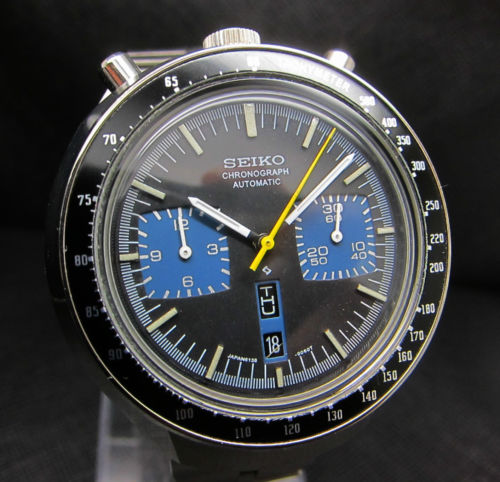
Seiko Automatic 12-Hour "Bullhead" chronograph


Today's watch is the super-cool, super '70s Seiko "Chronograph Automatic, " or "Seiko Bullhead Chronograph" as it's come to be called by collectors. So named because the pusher buttons are at the top of the case (rather than the side) and are reminiscent of a bull's horns, with the crown between the two pushers completing the look of a bull's head.


I've also heard it called the "UFO" due to its flying saucer appearance.


Seiko made this chronograph model from about 1974 to 1979.

Here are the details on this particular specimen: All stainless steel "hidden lug" case with screw back. Case 46mm high by 43.5 mm wide, not including crown, 46mm high, and 15mm thick. The head alone on this watch weighs 3.3 ounces. Few dings on the case, nothing serious. Bezel insert is in excellent condition. Excellent condition original dial, brown with gold colored registers. Excellent original crown and original pusher buttons. Crystal is a replacement, a correct beveled edge glass crystal.

Movement: 21 jewel Caliber 6138 movement winds and sets perfectly, keeps time to within 2 min/day. All chrono functions operate perfectly ... start, stop, and reset. Chrono zeroes up perfectly. Not known when last serviced. Day and date are both quick adjustable by pulling out crown to first "click" and turning clockwise to adjust date, and counter-clockwise to adjust day.


Brand new aftermarket "fishbone" bracelet with signed Seiko deployment clasp. The case serial number of 658296 dates this specimen to May 1976.


The Seiko "Chronograph Automatic" really shook up the market in its day because this 12 hour model sold for quite a bit less money than 12-hour chronographs from such companies as Heuer or Breitling. First models of the Seiko sold for around $145, while a Heuer Autavia retailed for around $230 with a steel bracelet. Seiko's chronograph sold quite well in the states because Seiko had already established a solid reputation. The idea of no running seconds already had a precedent with the Caliber 11/12, made by Dubois Depraz with financial and technical assistance from Heuer, Hamilton/Buren, and Bretling. All of these companies had an interest in this chronograph movement and would eventually come out with chronographs containing the Caliber 11 and its improved version, the Caliber 12.

The Seiko 6138 was quite a mechanical marvel in its time, and I believe matched the technical excellence of not only only the Caliber 11/12, but also the Zenith Caliber 3019, used in its El Primero automatic chronograph. Granted, Seiko had five years to study those movements and learn from them, but take into consideration that Seiko made the movement entirely in house, including escapement and hairspring. The movement is amazingly durable. Even the most cosmetically beat up specimens frequently have working movements!

Today, the Seiko Bullhead is popular among collectors, partially because they provide the biggest bang for the buck for a 12-hour chronograph. But they are going up in price. A few years ago, you could buy them all day long at $250 and under, many complete with the watch's signature "fishbone" bracelet. Now, it's not unusual to find them starting at $350 to $450, and if you find one with an ORIGINAL fishbone bracelet (not aftermarket) you can add another $100 to that price.

Because it sits so high on the wrist, the watch tended to get banged around quite a bit, both on the sides and on the surface of the bezel insert on which is printed all the tachymeter numbers for calculating speed of a moving object. This specimen has a few dings on the case, but the bezel insert is in surprising good shape.

Two color combinations of this model were offered. This one is the brown dial with gold colored registers; the other is a black/blue combination. I'm not aware of one color combo being more desirable than the other.

The crown on this watch can actually be used as a secondary means to wind the movement. Most Seiko automatic utilize the crown only to set the time and calendar functions as needed. They rely solely on the rotation of the rotor to wind the mainspring.

This is one watch that definitely requires a bracelet. A leather band on this watch looks ridiculous in my opinion. The best option for a bracelet is of course the original "fishbone" bracelet that it came with. The bracelet has earned the name among collectors because the thin inner links of the bracelet look like the bones of a fish once it has been filleted. The problem is, original bracelets are nearly impossible to find because they tended to take quite a beating by their original owners. Enter the Chinese, with their amazing ability to duplicate nearly anything, especially once it's learned there is a demand for it! There are a number of sellers on eBay offering aftermarket "fishbone" bracelets, specifically for the Seiko Bullhead that are near-perfect replicas of the originals, right down to the perfect fit between the end pieces and the watch's lugs. The bracelets sell for between $35 and $50. They are generous in size (I'm certain they will fit up to an 8-inch wrist) and, honestly, I have no problem attaching one of these to a Bullhead (as I have with this one) as long as one is honest about disclosing the fact.

I should add that complete Chinese-made fakes of the Seiko Bullhead have appeared on the market. They are fairly obvious to spot. Apart from the fact that most are shipped from China (which should raise a red flag immediately) the aftermarket dials and hands are fairly easy to spot. But just be aware. Here is one such example:


Here are some additional photos of this REAL ONE I have:


The watvh is for sale, and if you'd like to make an offer on it, please contact me by clicking here.

You can see my complete listing of watches for sale here.

Hope you have enjoyed this blog entry!

Sincerely,

Bruce

Friday, June 3, 2016

Rare 1936 Hamilton Taylor with Swivel Lugs

Here's one for you Hamilton lovers! A rare 1936 Hamilton "Taylor":


This specimen has a 14kt yellow gold filled case measuring 40mm long tip to tip, by 21mm wide. Case is in very good condition. Few flea bites on bezel corners but most gold filled on the decorative embellishment is intact.


Back is monogrammed "EJ".


And the case manufacturer on this model was the Stat Watch Case Co. of Ludington, Mich.


Good original dial, some darkening, but still very readable. This is the dial option with the gold applied markers. The other option from Hamilton was black inlaid enamel numerals. Crown appears to be the original, or at least a replacement that is correct to the period.


Glass crystal is most likely a replacement. 17 jewel Grade 980 movement winds smooth and sets perfectly. Keeps time to within 2 min/day, but unknown when last serviced. Serial number of G77186 corresponds to 1935-'36 date of manufacture, so the movement is age-correct to the watch, and I believe the original.


Finished with a new old stock Speidel 16m black leather band.

The "Taylor" model is quite interesting, and was only made for one year in 1936, and then discontinued. A brief notation from company sales reports indicates that that Taylor was "renamed" the Talbot in 1937. However, you can see that the two watches, while similar, are distinct from one another:


Taylor                                        Talbot


The Taylor has decorative embellishments on the bezel along the top and bottom. The Talbot's bezel does not have these embellishments. In addition, the lugs on the Talbot are fixed; they do not swivel. Hamilton likely found out early on that the hinged lugs were problematic, and remedied the situation with the new case design. In any event, the Talbot didn't do much better than the Taylor; it was discontinued after its appearance in the '37 catalog.

There are no factory records indicating how many "Taylors" were made. If not "rare," then at least this model is "unusual," and this is the first one I've ever seen. I would suspect only a fraction of these have survived in the ensuing 81 years because all of Hamilton's hinged lug models (Piping Rock, Pierre, Wilshire, etc.) were known to be fragile and prone to breaking whenever the delicate lugs took a hard knock. Many are the Piping Rock specimens out there with repairs to the lugs!

I think overall, this is a very nice specimen, and the piece is already in the hands of an astute Hamilton collector just a few days after I acquired it. If you ever see one of this, you should probably pick it up!

I would like to thank Dan Keefe for his help on this blog entry. If you don't know about his website (click here) you should check it out. It's one of the best sites I've ever seen for Hamilton watch collectors!

Cheers,

Bruce Shawkey

Monday, May 23, 2016

Rare 1930s Rolex Tudor ... a Wilsdorf Blunder Turned Blockbuster


This entry's little treasure is a Tudor dress watch from the 1930s. Gold filled bezel with "Staybrite" steel back. The case measures 37mm long by 26mm wide. It's powered by the 15 jewel Tudor Caliber 59 movement, built on Fontainmelon's Caliber 30 ebauche.


Impossible, you say. The Tudor watch wasn't invented until 1946, right?

Not so, as it turns out. Before Tiger Woods, before the "Rose" logo, there were the first generation Tudor watches. Not many folks know this, but Rolex registered the brand name "Tudor" way back in 1926, a full 20 years before the Tudor Watch Co. went into business. How do I know this? Because it's right on the Tudor website! (1)

It was kind of crazy time for Rolex back in the '20s ... a decade of prosperity. Company founder Hans Wilsdorf was bulk registering all kinds of brands -- some of them rather crazy -- in an Edisonian effort to get his hands on as many names as possible. In 1920 alone, he registered 18 brand names. Many of them were never used. My personal favorite is LON, which stood for League of Nations!

Then, Wilsdorf happened upon the name Tudor. The story goes it was one of his personal favorites because it paid homage to Britain's Tudor era. (Remember that Wilsdorf, born in Germany, had become a British citizen by this time). Rolex sat on the brand name for several years, but in the 1930s finally decided to do something with it. At least one watch historian (2) believes the brand represented an early version of what Tudor would become when it was launched on a wider scale in 1945 --- a sort of "starter watch" for the budget conscious person who would eventually "move up" to a Rolex. Here's an early version, made for Catanach, a respected jewelry firm in Australia:


Early Tudor, chrome case, quadrant dial. Notice
the signature logo, with the horizontal bar
of the "T" extending over the rest of the letters.
Image from www.tudorwatch.com.

Judging by how few of these we see today, the brand was not a success. Wilsdorf's timing couldn't have been worse, no pun intended. The United States was in the midst of the Great Depression, with the ripple effects being felt worldwide. Fast forward to 1946. It was now the perfect time to relaunch the brand. There was a huge market for watches, caused by pent up demand from World War II. Consumers needed a good watch, but at a good price because the prosperity of the 1950s was still a ways off. Enter Wilsdorf with his "new" Tudor, a starter watch guaranteed by the full faith and resources of Rolex.

But back to our example. The inside case back is signed "Handley," which at first glance appears suspect of a recasing.


However, we know that Rolex exported many of its watches in an unfinished state, to be cased at the country of ultimate sale. This was to save on import duties. Handley (full name J W Handley) was probably Australia's largest casemaker at the time, located in Melbourne. So I believe this is another watch that was exported to Australia like the Catanach mentioned above. I have every reason to believe this watch is in its original state.


With the case having wire lugs, I've attached an 18mm open-ended tan pigskin band to the watch. The watch has just been serviced (April 2016) by my watchmaker. It sets and winds perfectly, and keeps good time for a watch of this vintage. The crystal and crown I'm certain are replacements, but serve their function.


It's difficult to put a price on this watch. It's one of those pieces that's "rare," but as we all know, rarity alone does not determine value if there's not a demand for the watch. This is a watch that is obviously looking for a collector who specializes in early Tudor. I've seen one in a 9kt gold case priced at 875 British pounds, which is $1,268 in U.S. dollars. I believe that's a "wishful thinking" price, and I have a much more modest price in mind for this specimen. It's for sale on my website (click here) for $295.

Cheers, or should I say, g'day.

Bruce

Footnotes:
(1) http://www.tudorwatch.com/magazine/article/tudor-history-origins-1926-to-1949
(2) My source on this is the author at http://www.vintage-watches-collection.com/watch/rolex-watch/rolex-tudor-gold-cushion-very-early-1935/


Saturday, May 14, 2016

Waltham 1917 Trench Watch with Gold Overlay Back

Hello friends and customers.

Another terrific acquisition this week. I was going through some collector's stuff, and spotted this Waltham military watch with yellow engine turned back covering a white metal case:


He sold it to me very reasonably because he thought it was a put-together case! However, I remembered in Stan Czubernat's Waltham book that there was an entire chapter devoted to these cases.

Sure enough, I got it home and it turns out to be an example like the one on page 98 of Stan's book, called the "Cadet." Stan believes that this case was designed by Ezra Fitch himself, then head of the Waltham Watch Co. Fitch was an avid wristwatch proponent and probably as responsible as anyone for bringing the man's wristwatch out of the novelty realm and into the mainstream. He held several case patents and worked closely with Charles Depollier in manufacturing the Waltham/Depollier Waterproof Watch, arguably the finest and today most sought after trench watch model of the Great War.

Anyway, Fitch had some rather eccentric ideas about the caseback of a watch, notably that a back made of gold (or at least the application of a gold layer) would better disperse the body heat of the wearer and thus protect the watch's movement from excessive heat. Experience has shown us that this concept is rather silly, but Fitch believed it fervently, and thus designed this case. To this day, we do not know who manufactured the case for Waltham, but it is 100 percent legitimate to this "Cadet" model, and the inside of the case back is stamped:


"WALTHAM
14KT GOLD ON
WHITE METAL"

and then the number 22432 is stamped below this, which I assume is a case serial number.


Upon further examination, we find that the movement's serial number of 20,955,090 is a 3/0-size Grade 361 movement with 7 jewels, manufactured in year 1917. This serial number definitely puts the watch in the range of the Great War. Whether it saw actual service or not is anyone's guess. Its wonderful condition suggests that it did not see service, but you never know. The watch runs in its current state, and even keeps respectable time, though I have no idea when it was last serviced.


The black dial with luminous numerals I thinks adds further value to the watch, since most of these I've seen have white dials. The dark condition of the luminous and the fact that a good portion of it is missing suggests to me that this is an original dial, and I for one would not have this dial refinished in a million years!


The crown I believe is also original.


Finding this watch is a great example of how having a little upper hand on knowledge can pay huge dividends when you're out searching for watches. I have never quite understood the reluctance of so many watch collectors to acquire reference books. They view it as an expense when in reality it is an investment that often times pays for itself many times over. The other nice thing about this watch is that it was obtained from an estate. Don't get me wrong; I love buying watches from other watch dealers. But some of the finest, most original-state watches I've acquired over the years are what I call "organic" watches. These are watches that have the least likely chance of being "molested" or "messed with." Like the "field-to-consumer" organic fruits and veggies, these watches haven't passed through multiple middlemen where all manner of molestation can occur ... re-casing, swapping dials/movements, etc. I am 99% sure that this watch is all original. Quite a feat for a timepiece nearly a century old! 

Stan's book places a value on this model of between $900 and $1,000. But keep in mind that is for a watch in fully restored condition, with the movement completely torn down, cleaned/oiled, and re-assembled. I conservatively believe the black dial would add another $100 to $200 to that figure.

This specimen is for sale on my website, and can be found here, until it sells of course!

Happy collecting!

Bruce

Friday, May 6, 2016

Outstanding Acquisition -- Gruen Pan American With Rare Sub Seconds

In 1943, the Gruen Watch Co. came out with a special watch for pilots and other flight personnel of Pan American World Airways, commonly known as Pan Am. At the time, Pan Am was one of the country's principal airlines, and the largest international carrier.

The watch dial had numerals for 1 through 12 as well as 13 through 24, so that time could easily be read in military time to distinguish a.m. from p.m.

While it was intended to do so, the model caught on with the general public, and several civilian models were made available after WWII. Over the next four years or so, Gruen came out with about 14 mens models and three women's models, presumably for female pilots and stewardesses (sorry PC-ers, but that's what they were called back then).

Recently, I had a chance to acquire this one:


The peculiar thing about this model is that it has sub seconds. All other Pan Am models had sweep seconds hands, and the efficacy is obvious: It is much easier for a pilot to keep track of seconds using a larger center sweep seconds hand. Why Gruen even made one with a sub-seconds is kind of a mystery, because it defeats the whole purpose of a watch designed for flight personnel!

The short production time of the Pan Am (1943-1949) makes most any genuine Pan American model hard to find. I emphasize genuine because numerous "put-together" Pan Ams surfact on the market regularly. Rarer still is the sub-second variety. Few of these models were ever sold, and fewer still survive today. Thus, the sub-seconds Pan Am has become a sort of holy grail for collectors of this sub genre.


The case for this model was not made by Wadsworth or Star, two of Gruen's usual case suppliers. Rather, it was imported from Switzerland. The bezel was made of base metal, while the screw-on back was made of Guildite, which was Gruen's terminology for stainless steel.


The caseback is stamped "GRUEN PANAMERICAN" on the outside and marked "Guildite" and "Switzerland" on the inside. This imported case was made for at least one other model (with the usual sweep seconds hand) and possibly others. It is 32mm diameter, and close to 40mm long, lug tip to lug tip. It was a very standard size men's wristwatch for its day, though is small by today's standards.


As you can tell by the profile image above, the case has pierced lugs. The dial and hands are original. Some of the luminous has fallen from the numerals and hands, very typical for a watch of this vintage. And look at the dial carefully. Notice anything about the luminous on the numbers? It's only only on the 18-24 on the outer ring, and 1-5 on the inner ring. The rest of the numbers are just black ink. This is because the night time hours were set up to glow in the dark ... a hand feature for a pilot. Also on the dial, you see one small scratch near the center post where no doubt some watchmaker was careless removing the hands. But overall a very nice original dial, and I wouldn't refinish it in a million years.


The engine on this model is the Grade 420, an 11.5-ligne movement that began production in 1942. Normally, you would find a Grade 420SS in this watch, the primary movement used in Pan Am series.

Overall, I would rate this specimen a very good, a solid 70 to 75 on a scale of 100, with 100 being new old stock. There is some pitting on the bezel, which is consistent with a watch that was used but not abused by its original owner. The watch was (and is) in good running order when I received it, and is keeping time to the minute within a 24-hour period. Thus, I have not had the watch serviced. This watch came out of an estate, and I am confident it is 100 percent original, and not put together from parts.

I have several Pan Ams in my collection, but this is the first sub-seconds model I have ever acquired. This is one of those "must-have" watches for any serious collector of Gruen wristwatches, especially the Pan Am series.

This specimen is for sale on my website, and can be found here, until it sells of course!

Sunday, April 3, 2016

Trench Watch's 100th Anniversary, Part III

In this next installment, we continue to look at how the trench watch continued to evolve into the archetype of the modern wristwatch that we know today, 100 years later. The next essential element, following the movement and dial, is the case.

When the first men’s wristwatches were produced, the wire lugs that were soldered onto cases were quite thin because no one expected that these watches would be used for anything beyond light activity. However, when America entered the war, it quickly became evident that something thicker would be needed to withstand the rigors of the battlefield. Nevertheless, cases with thin lugs were the style most readily available by the major case manufacturers of the time: Illinois Watch Case Company, Fahys, Wadsworth, and others. Thus, the majority of trench watches that you will encounter will have these thin lugs. Notice, also, the oversized, knurled winding crowns. This was a deliberate design element to help soldiers wind their watches with cold, or even gloved, hands.

Typical case design of a WWI trench watch

Probably by the middle of the war and certainly toward the end, the fragile nature of these cases had become evident, and manufacturer were making cases with meatier lugs.


Another major problem with early watch case designs is that they were not very resistant to the elements. Dirt, moisture, sweat, and mud would often seep through the case and into the movement, causing it to stop. Several manufacturers invented various solutions to deal with this, but probably the most famous was Charles Depollier, of the Depollier Watch Case Co. of Brooklyn, NY.
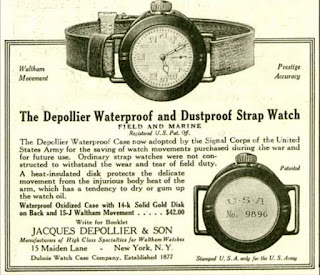

Advertisement for the field and marine watch
featuring the Depollier Waterproof/Dustproof
case, and Waltham movement.

An actual specimen of the watch

Depollier’s case contained a screwdown bezel and back, combined with a screwdown crown to seal all the entry points. The back even had an extra plate of solid 14kt gold, supposedly to protect the movement from excess body heat. A bit of overkill in my opinion, but it was a great selling point at the time. The resulting Depollier Waterproof Watch Case was probably the finest example of wrist hardware that a soldier could wear at the time. Depollier partnered with the Waltham Watch Co. to make the complete watch, and it was a very successful venture. The watches with the Depollier case were available to soldiers as early as 1917. Many were contracted by the U.S. military, and many more were bought by soldiers and officers out of their own wallets. Some say the Depollier waterproof case was the inspiration for the Oyster case, made famous by Rolex a decade later. Today, trench watches housed in the Depollier Waterproof cases are some of the most desired by collectors. They are hard to find, and priced in the thousands of dollars. It is doubly rare to find one with the original solid gold back plate, as many of these were pried out of their cases and sold for scrap.

Crystal Guards

Next, we move on to crystal guards. From the earliest days of pocket watches, it quickly became clear that the crystal – made of glass -- was the most vulnerable point of a watch. Cracked or shattered, it left the dial and hands wide open to damage, not to mention dirt, moisture and glass fragments getting into the movement and damaging it. A couple of solutions for wristwatches were offered early on. The first was a case design with cutout coverings of one form or another that partially protected the crystal.


A couple of problems arose with this solution. One, these cases tended to be expensive and, two, many of covers nearly obscured the dial to the point of not being able to tell the time. So a second solution came along in the form of shields that could be snap fit over the top of an open case, and thus the crystal guard was born.


As you can see, they came in a host of designs, and again some covered the crystal so much as become a hindrance in viewing the time. But they did a good job of preventing crystals from being broken or shattered from bumps or hitting the ground from a soldier literally having to hit the dirt.


Somewhere along the 1980s, some collectors and dealers started calling these inventions “shrapnel guards,” probably because it sounds more sexy than crystal guards. But they were never called shrapnel guards, and the very idea that these covers would protect the watch from shrapnel is ridiculous. But the myth persists, legitimized by collectors guides which use the term. Trust me, it’s wrong. I’ve seen about 30 original ads for these devices, and they were NEVER referred to as shrapnel guards.

By the way, beware of modern counterfeits on these. The real ones will almost always have a patent mark and/or patent date stamped into the back.

Bands.

As you have seen in many of prior images, early watch bands, or straps, were narrow strips of leather or canvas that looped through the wire lugs of a watch. This was fine for motoring or horseback riding, but it was evident that something more substantial was needed for the rigors of the battlefield. Numerous designs were introduced, probably the most famous was the Kitchener watch strap.


Not only was it more sturdy, but it allowed for leather to sit against the wrist rather than the metal of back of the watch, which was ultimately more comfortable and absorbed sweat. Just as an aside, I find it amusing that this style briefly came back into vogue in 1970s in the form of the “Hercules Watch Band.”


So in the short span of two years, from 1917 to when the Great War ended in 1919, the wristwatch had undergone a fairly radical redesign, from somewhat feminine to something fairly macho. Look at the difference:


During the war, and right after, watch cases would undergo the next step in their evolution through a design where the lugs were fully incorporated into the case and were not soldered onto the case. And so we have the full formation of the modern wristwatch as we more or less know it today.


But I would say the vast majority of watches worn during the Great War were of the wire lug variety. You might wonder how many watches the military ordered during the war. We don’t really have any records that have survived, at least not that we’ve found, but surely it was in the tens of thousands. To give you an idea, here’s a picture that’s been seen often on the Internet of one jewelry store that bought up a bunch of surplus watches after the war.


Wouldn’t you like to have bought up a bunch of these watches at four bucks apiece? And straps for 10 cents apiece? And these watches are probably those that were issued by the government. Many other service men – particularly officers – who weren’t issued a watch often bought their own in fancier – gold and silver – cases.

The war’s end drastically changed the way the wristwatch was advertised and perceived by the public. Even though pocket watches continued to dominate the market until the early 1930s, the wristwatch was now solidly a masculine item. Here’s one of my favorite ads:

Image by watchophilia.com


What to look for when buying a trench watch

Let’s spend a few paragraphs summarizing what to look for when considering a trench watch purchase


  1. Originality or at least replacement parts correct to the age of the watch. This especially includes the movement, which should have a serial number corresponding to the war years. Crystals should be glass, not plastic. Crowns should be correct to the period. Crystal guards, if present, should be genuine and fit snugly to the watch.
  2. Engraving is good! Many watch collectors do not like personal engraving on the backs of their watches. But trench watch collectors LOVE engraving, particularly if a name is combined with a date and/or military unit. It helps immensely to authenticate the watch as a true trench watch that saw actual military service, as opposed to a civilian specimen. It’s important to remember that these trench-style watches were available to the general public as well as military personnel, though it’s correct to call either a “trench watch.”
  3. Mechanical condition. Watch movement should wind and set smoothly, with no “grinding,” or “skipping,” indicating worn parts. Accuracy is not a huge concern to most collectors, but the watch should keep time to at least within 2 min/day.
  4. Manufacturers. Most trench watch collectors seem to focus on U.S. brands, and particularly Waltham and Elgin. But to the best of my knowledge, all U.S. manufacturers made trench watches. Not all U.S. manufacturers, however, contracted with the U.S. military.  But as was pointed out in #2, “trench watch” refers to a style of watch, not necessarily whether the watch saw actual service or not. So watches by Illiinois, Hampden, and Hamilton from the 1917-1919 period could rightly be called trench watches as well. Things get a little more dicey on the Swiss side. We know that companies such as Omega, Tavannes, Longines, and more made watches that served on both sides of the battle … the Allies, and the Central Powers. But this is an area which, to my knowledge, has not been well documented. So if this collectors’ niche is of interest to you, proceed with caution. I’ve seen watches for sale/auction on eBay, for example, that are CLEARLY ladies’ wristlet watches, but are being offered as “trench watches.” Proceed with caution. Seek help from fellow collectors on trusted and well respected Internet forums.


Finally, I want to show you a couple of pictures of current production watches to show you how incredibly practical the design of the wristwatch was nearly a century ago.


Look familiar? These current production watches draw heavily of the design elements of a century ago, and they look completely up to date!

That’s the end of my series on trench watches, and I hope you have found my stories informative. If you have enjoyed this work, please leave a positive comment!