Sunday, August 21, 2016

Atlantic "Stop Chronograph" Fun at a Fraction of the Price of an Omega "Chronostop"

© 2016 Bruce Shawkey

I've long maintained that there a TON of watches out there that are unusual, interesting, even rare, that don't cost a lot of money. You don't have to break into the 401(K) fund to have some fun in this hobby.

Take for example this Atlantic stop timer chronograph.


It sort of looks like a chronograph, but without the registers. The top and bottom buttons merely freeze the sweep second hand (top button) and reset the sweep second back to zero (bottom button) whereupon it resumes its sweep as a normal second hand. The freezing of the second hand is a little different from a "hack" feature found on some sport and military watches in that it does not stop the whole movement. In other words, the watch keeps on keeping time, even when the top button is depressed. In this way, the watch does not lose time when the stop feature is being utilized.


Atlantic watches have quite a history, going back to 1888 when Eduard Kummer (born March 26, 1845), established the EKB (short for Eduard Kummer Bettlach) company in Bettlach, near Grenchen, Switzerland. That original name stuck until 1952, so adverts up to that time are seen with the name "Ed. Kummer." Ads after that depict the "Atlantic" name, and sometimes Ed. Kummer, and sometimes the name "Aristex" which was another brand name the company came up with. (Ariston and Opus were two other brands of the company as well.)


Like many watch companies, Atlantic flourished in the years immediately following World War II, when the floodgates opened due to pent up demand for consumer goods during the war. Atlantic came out with many model names, but perhaps their most famous was the "Worldmaster." Also like many watch companies, Atlantic began to disappear in the '60s with the market gravitating toward cheap, disposable watches. The '70s delivered the final blow with the introduction of quartz watches. In 1989, a company called Uhren Verkaufs Büro (UVB) acquired distribution rights to the brand. That company went bankrupt in the early 1990s, and now the Atlantic company distributes its own watches, currently focusing on the Eastern-European markets. "Worldmaster" in the main model it promotes. Here's one from its current lineup, an homage to their original Worldmaster from the '50s:


All of their vintage wristwatches utilized ebauches (rough movements) from other suppliers such as ETA, Fountainmelon, A. Schild, and others. This was a very common practice in its day, since the Swiss watch industry had by this time divided itself into specialty companies. One group of companies made the vast majority of raw movements and sold them to watch companies where they would be "finished" in house, including polishing/plating of the plates, adding a custom part or two, or perhaps an in-house "module" of some kind, etc. Other Swiss companies made cases, while others made dials and hands, and so forth. That is why so many watches from supposedly competing companies from those days bear a remarkable resemblance to one another! (The practice continues to this day; many watch companies buy their movements and cases from the same handful of suppliers.)

The Atlantic stop timer chronograph utilizes the ETA Caliber 1168 movement.


The direct sweep second is continuously running, and is coupled to the fourth wheel with a latching axial clutch. The pusher at the 2:00 position stops the second hand as long as held down. The pusher at 4:00 resets the second to zero, and restarts it when released. Several companies used this movement, including Breitling, and promoted the watch to physicians, time/motion study scientists, technicians, photography darkroom enthusiasts, etc., just about anyone needing a watch to measure short bursts of elapsed time, while maintaining constant time like a "normal" wristwatch. Perhaps most famously, the Omega Watch Co. utilized this concept on their "Chronostop" model, although their movement is based on a Lemania ebauche.

You can see the ETA 1168 in motion at this link:

http://www.dailymotion.com/video/x1a4kzj_eta-1168_tech


It's labeled "Wall" watch company, but the movement is the same as inside the Atlantic.

In any event, it appears that Atlantic did not have great success with this model, due to its limited timing ability. I'm not even aware that Atlantic gave it a specific model name.

The specimen I have measures 42mm long lug to lug, by 35mm wide, not including any of the crowns. The case composition is chrome plating over base metal for the bezel, with a stainless steel snap back. The bezel shows this was well used (but not abused) by its original owner. Pitting is evident, but not severe. The dial is original and still in very good condition. The hollowed-out arrow hour and minute hands add a nice note of eccentricity to the piece. The watch came to me with an ill-fitting winding crown, and one of the pusher crowns was missing. In restoring this watch, I had to use a hodgepodge of crowns due to weird tap sizes on the stems. Not the most pretty, but everything works as it should. The watch kept acceptable time when I received it, so I did not bother to have it cleaned/oiled/adjusted. (If it ain't broke, why fix it?)


I hate to reveal the exact price I paid for it, but let's just say it was under a hundred bucks. I want to play with the watch for a while, but eventually it will be for sale on my website!


If you are interested in learning more about Atlantic watches here are couple of links:


History (this is a link that will download a PDF containing lots of info about Atlantic)

The current Atlantic (this the link to the company website)


Thanks for reading, and I hope you encounter some unusual "finds" in your travels as well!


Bruce Shawkey

Thursday, August 4, 2016

Zodiac revisited


Note: I originally wrote this story for the NAWCC Watch & Clock Bulletin (W&CB) for the March/April 2016 issue. But due to differences between myself and the new editor that could not be resolved, the story never ran. So here it is for your hopeful enjoyment.

By Bruce Shawkey

I have long admired the Zodiac brand of watches for their great quality and affordability. They fit right in with the philosophy of this blog --- that great vintage watches need not necessarily be expensive. I first wrote about Zodiac watches in August of 2005 for the W&CB. Since then, there have been several significant discoveries and developments about the brand that I wanted to share with you.

But first, let's review the history of Zodiac from inception to year 1978 for those of you who don't have access to W&CB. (The significance of year 1978 will become clear in a few minutes.) This history is well documented on numerous websites, so I am only going to do a few bullet points from their highlights. If you want more info, I suggest you visit www.vintagezodiacs.com.


* 1864: Ariste Calame (1839-1917) establishes a workshop in LeLocle, Switzerland. The company is founded in 1882 and is known simply as "Ariste Calame." The name "Zodiac" is occasionally seen on some pocket watches, but was not trademarked until 1908.

Ariste Calame


* During the early years, the company manufactures movements and movement parts for other companies, notably Favre-Perret and Seiko of Japan (believe it or not, Seiko has been around since 1881).

* 1895: Son, Louis-Ariste Calame, takes over the company. Other family members join the company and the company remains family owned and operated until 1978.

* mid-1930s. Zodiac builds a series of in house wrist watch movements. Two notables are an eight-day Caliber 1551 movement, and another (Caliber unknown) with a patented shock-proofing system. In the photos below, you can see the patented "Z-clip" over the balance that provides shock protection.


Both movements are so obscure they are not even listed in the Bestfit material catalogs. Zodiac decides to use ebauches (rough movements) from other companies and merely finish them in house.

* 1953: Zodiac introduces the Sea Wolf, the first serious watch for divers. It as a turnable bezel ring to measure elapsed time so that divers can keep track of oxygen remaining in their tanks.


The watch is an instant hit not only with divers, but other sports enthusiasts seeking a robust watch with easy-to-read dial. Underwater Demolition Teams (UTD), which later became the Navy SEALs, choose the Sea Wolf as their "official" watch over their government-issued watches. The model remains the company's signature watch to this day.


* 1971: Zodiac introduces the "Super Sea Wolf" with even great water resistance and incorporates orange into the dial and hands to make it even easier to read.


* 1971: The company introduces the "Astrographic" a unique automatic mystery dial watch. Dial calibrations are decaled onto the underside of the crystal. The model is made in round and square/cushion shape versions. The watch was a huge hit with consumers. Not only was the watch a novelty, but it was seen as a robust sport watch (complete with bracelet instead of leather band) AND it was automatic.


* 1978: The last generation of the Calame family sells the company to a large Swiss corporation, and Zodiac is no longer family owned.


OK, so much for the history up to 1978. The first development I want to talk about are the crystals for the Astrographic models. The problem was (and is) that if the crystals are scratched/scuffed (and they always did), you could only get the crystals from Zodiac. And when the company fell on hard times beginning in the late '70s, production of crystals (and indeed replacement parts for most vintage Zodiac watches) ceased, and existing supplies quickly dried up.

Enter Thomas "Andy" Lewis, a watch technician and Zodiac collector from Ohio. He’s found a source to make the crystals for both the cushion and the round models, complete with the underside decals.


As you can see, Andy's replacements (bottom) are very close to the originals (top). 

“The crystals that I have made are hardened mineral glass, so they are slightly superior to the originals,” says Lewis. “Another huge benefit over the originals is that mine are designed to fit the case exactly and be glued in. No need to worry about the gaskets that came with the old crystals and had to be installed to make the crystal fit correctly.” Lewis sells the crystals for $75 each plus shipping (uninstalled) and you or your watchmaker can install them (Lewis recommends ultraviolet cement). Or for an extra charge, Lewis will install it, though I recommend doing it yourself (or your watchmaker) since Lewis is almost always overbooked with repairs. He also sells crystals for Zodiac’s “Super Sea Wolf” (also long unavailable from Zodiac) but these Lewis must install himself due to tiny variations in bezel sizes during the years the model was produced. To contact Lewis, visit www.ultra-vintage.com.


KEY PLAYERS IN ZODIAC’S LATER HISTORY

Another facet of my 2005 story on Zodiac that I want to expand upon is the ownership of the Zodiac brand after the Calame family sold it in 1978. As previously stated, a large Swiss consortium (Dixi Group), bought a controlling interest in the company starting in 1978, and gained total ownership by 1979. The Calame family, which had run Zodiac since its beginning 1882, had simply floundered starting in the late ‘60s due to cheap Swiss mechanical export brands, Then, quartz watches delivered the knockout blow in the early- to mid-1970s.

The next 11 years under Dixi ownership are generally regarded by vintage Zodiac collectors as the “dark years.” The brand all but lost its focus on its core market of sports watches, opting instead for dress watches of uninspired copycat designs of other manufacturers.

Then, in 1990, a savior of sorts arrived in the form of Willy Gad Monnier, a well known figure in the Swiss watchmaking industry.

Willy Gad Monnier

Since the end of WWII, Monnier had climbed through the ranks and was perhaps at the pinnacle of his career with Heuer/Tag Heuer, even being CEO of that company for a time. But his calling presumably lay elsewhere. With a long-held passion for sport watches, he was saddened to see what had become of Zodiac and thought he could bring the brand back. So in a rather acrimonious parting with Heuer/Tag Heuer, Monnier purchased the brand. A 1990 brochure heralded the return of the Sea Wolf and Astrographic. Other iconic models would soon be re-introduced, including the SST 36,000, the Aerospace GMT, and the Corsair.

Despite these efforts, the company went bankrupt in 1997. In Sept. 1998, another rescue attempt was made when Genender International, Inc. (a U.S. company based in Wheeling, Ill.) bought Zodiac’s remaining inventory, all of their trademarks and registrations and other assets out of bankruptcy from the Swiss Courts. Early on, these were generally happy times for Zodiac enthusiasts, as Genender attempted to re-energize the brand, and stay true to its heritage of sports watches. Toward the end however (2000-2001) the brand faltered, mostly because Genender was unable to find a steady and reliable source of mechanical movements. Models were “shuffled” between quartz and mechanical to ration mechanical movements. There were highs and lows. Genender re-introduced the Astrographic in a new iteration, the Astrographic 2000, which today is highly sought by vintage collectors. It is believed that fewer than 500 of these were made during a 13-month period from 2000-2001

Photo by Renaissance Man 


Sadly, the iconic Sea Wolf was dropped in favor of a new “Sea Wolf II” which was only offered with a quartz movement. In 2001, Fossil Inc. approached Ken and Alan Genender, principals of the company, accepted an offer of $4.7 million for the Zodiac brand. It is one of the rare occasions in which the price paid for a watch brand is revealed, owing to the fact that Fossil Inc. was (and is) a publicly traded company (NASDAQ: FOS) and capital acquisitions must be reported to shareholders.

(Alan Genender, by the way, is currently reviving the Clebar brand (both chronograph and time-only), which for years was closely associated with Zodiac. I'll cover that in another blog entry. But in the meantime, check out the company and its watches at www.clebarwatches.com.)

I expand upon the various owners because die-hard Zodiac collectors are meticulously fussy about the pedigree of various models. The Super Sea Wolf model is a typical example … collectors take great pains to distinguish a Calame-era model, from the vastly different Monnier-era model, and from current version offered by Fossil.

The Monnier-era Super Sea Wolf (left) and current version.


FINALLY, A CONTEMPORARY SEA WOLF

Another major development in Zodiac comes from the company that currently owns the brand – Fossil Inc. Back in 2005 when I first reported on the brand, Zodiac to my complete amazement had ceased production of the Sea Wolf, the company's most famous watch. This was, in my opinion, a huge blunder on Fossil’s part, sort of like if Chevy were to drop the Corvette. Well, the company has come around, and it now offers a model called the Super Sea Wolf 53.


It’s been updated somewhat to reflect current tastes. For example the watch is 40mm in diameter versus the original watch at 35mm. But the watch is very true to the original spirit of the watch, (notice the reference to 53, the year the Sea Wolf was introduced), including a mechanical automatic movement, not quartz. And it’s priced at $1,295 retail ($1,095 if you’re willing to forego the stainless bracelet for a silicon strap) which in today’s world of mechanical watches is quite affordable.

The company also offers a "Super Sea Wolf 68" which is a tribute to the original Calame-era Super Sea Wolf. I wish Fossil had not called both Sea Wolfs "Super" because it's kind of confusing but, hey, they never consulted me. Anyway, the retail price on that one is $1,595. They also offer an updated version of the cushion-shaped Astrographic, another watch that was missing from Zodiac’s lineup for several years. The Astrographic is priced at $1,295 and features a steel bracelet and mechanical automatic movement.

Why am I even reporting the "new" Zodiac? I realize that many of you vintage collectors don’t care for modern watches. But you have to remember there are many watch enthusiasts out there who like the “look” of a vintage watch, but want such features as newer, better materials and machining methods, a warranty, and true water resistance for swimming, diving, etc. … all things that a vintage watch cannot offer.

I have mixed feelings about whether to recommend buying current Zodiac models. While I'm happy that Fossil is finally bringing back the classic Zodiac models, Fossil is notorious for poor service, both to its retailers and to consumers. Retailers report they can't get band/bracelet parts and replacements. Ditto with case parts such as crowns and crystals. The Internet lists numerous complaints by customers about sending their watches to Fossil's service center (Metro Service Center in Dallas, Texas) which is also the same warranty service center for Zodiac. Fortunately, Fossil is a member of the Better Business Bureau, and the BBB has gone to bat for numerous consumers over the years and gotten results. But my question is, why does it have to get to that stage? Why doesn't Fossil resolve problems in the first place and avoid public airing of problems via the BBB?

So my advice with buying a current Zodiac is assume the best, but prepare for the worst. The watches do appear to be solid, and have gotten good reviews by several respected websites, including Hodinkee. But watches do break during the warranty period, so be prepared. Save all paperwork with your watch, especially the receipt. The warranty card typically means nothing without the receipt! Meanwhile, out-of-warranty service can probably be done on most models by a qualified watchmaker, since the movements in most of Zodiac's classic remakes are made by ETA. Exceptions might be the models with compression cases (Super Sea Wolf, for example) which would likely need to go to Metro Service for out-of-warranty service.


HEUER AND ZODIAC … NO CONNECTION

Finally, I wish to dispel a rumor that has started in recent years, and that is the notion that Heuer/Tag Heuer at one time made watches for Zodiac, that Zodiac watches are somehow a “poor-man’s version” of a Heuer/Tag Heuer. Even as I write this, there are several watches selling or recently sold on eBay described as being "made for Zodiac by Heuer." This is pure Internet urban myth, designed to artificially increase the perceived value of the watch, according to Butch Dunn, Zodiac collector, historian, and owner of the website www.vintagezodiacs.com. Says Dunn: “In 20 years now I have not turned up any documentation that ever confirmed, nor even suggested, that Heuer ever made any watches for Zodiac.” There are indeed several Zodiac watch models (chronographs in particular) that bear a remarkable resemblance to models by Heuer, and by other manufacturers for that matter. But that’s only because by the 1950s, most watch manufacturers were buying their cases, movements, dials, and bracelets from the same specialty companies, and assembling them into their particular version of the completed watch.

And speaking of Dunn, it is worth mentioning that www.vintagezodiacs.com is still the number one site (as it was in 2005) for the best and most complete information about VINTAGE (pre-Fossil) Zodiac watches. A companion site, www.zodiaccatalogs.com, operates on paid subscription and hosts an extensive collection of vintage Zodiac jeweler catalogs. Together, the two sites offer what I believe is the most comprehensive resource on vintage Zodiac watches to be found anywhere.

Enjoy! Oh, and by the way, please click on the link below to visit my website and see the awesome collection of vintage watches I have for sale!


Sincerely,

Bruce

Tuesday, June 28, 2016

Gruen Imperial Tank, Model Number 17

The Gruen "Tank" models, produced from 1929 to 1935, are particularly hard to find. It seems that it's easier to procure an 877 Techniquadron than a Tank! I've only come across two or three in the 30 years I've been collecting, and all of those have been the "small" Tank, measuring a mere 32mm long by 24mm wide, and easily mistaken for a lady's watch.

Imagine my thrill at being offered an "Imperial" Tank a couple months ago from a collector friend of mine. It was in rough shape ... a really bad dial, and a movement that was missing parts, although at least it had a good balance. I really hesitate to refinish the dial on a watch, but I think you'll agree the dial on this was too far gone:


In addition, it needed a new canon pinion and a minute wheel ... both were shot. I was able to scavenge both parts from a spare Grade 885 that I had in inventory. The dial and two hands went to Kirk-Rich Dial of California and were refinished at a cost of $149.50. (Guess they didn't have the heart to bump me up to an even $150!) Wow, redials are getting expensive, aren't they? But I think you'll agree Kirk-Rich did a kick-ass job:


I had Kirk-Rich do the luminous paint on the dial and hands in an antique tan color, so the dial looks aged, though artificially of course. This is my personal preference; there's something just too "shocking" to me about an 87-year old watch with green luminous that makes the watch look looks like it came right out of a gumball machine! Anyway, the clean/oil/adjust was $45, so I'm $194.50 into restoration.

The case on this Imperial Tank is 37.5mm long lug to lug, by 25mm wide, not including the crown. There is no mistaking that this was a man's watch, at least by standards of the day.


It is solid 14kt white gold. It is the Tank Model #17, as was recorded in the Gruen "Guild" master catalog of 1929. It is the same as the Model 16 in green solid 14kt gold. It has a very pleasing decorative engraving on the top and sides of the case.


The case is in excellent condition with no personalized engraving. The pierced lug holes are nice and round, not all stretched out from excessive wear.


Dial and hands, as mentioned, are refinished. Very nicely done, including the SWITZERLAND signature on the bottom. All Gruen wristwatches, at least those produced under Fred Gruen's aegis, are signed SWITZERLAND at the bottom, not SWISS. The story goes that Fred insisted that Gruen dials bear the name of the actual country of origin, rather than SWISS which is merely an adjective.

The crown is most likely a replacement, but it is a correct crown for the age. Acrylic crystal is also a replacement.

The Caliber 885 is a basic FHF (Fontainemelon) 10.5 ligne Grade 1186, finished in house at one of Gruen's facilities in Switzerland. With 15 jewels, it has hour and minutes only; no seconds.


The history of the Gruen Tank is interesting in several respects. They were only made for seven years, from 1923 to about 1930. If scarcity is any indication, the models did not sell all that well. The case design is quite interesting in that the back covers the complete watch, even the lugs.


Also, there is an extra collar between the stem and crown designed to keep out dust and moisture. I believe it is these two features that gave Gruen the idea for the name ... i.e, "built like a tank." The fact that the watch bears a striking resemblance to the Cartier Tank was, I believe, merely a coincidence.

Some believe it was Cartier that forced Gruen to quit making the Tank models because of a trademark infringement. But that is not the case. As best I can tell, Cartier did not legally register the trademark "Tank" as it applies to watches until the 1970s, and didn't begin enforcing it until the 1990s. It was in fact Bulova that sought to end the model's manufacture because the company claimed it had already patented the stamping process for making the "cover-all" back. Bulova ultimately prevailed in the lawsuit ("Kay Jewelry Co. vs. Gruen National Watch Case Co.") and as far as I am aware Gruen did not produce the watch after that. Whether sales of the Tank models would have continued into the 1930s is questionable anyway, since consumer tastes were running more toward the streamlined look versus "blocky" designs like the Tank.

In all, just 28 distinct Tank models were created that I am aware of. Fourteen of those were of the "Imperial" size, and of those just eight models were cased in solid gold. Which makes this "Tank" a rare find in my book. This one is going in my personal collection ... at least for now!

Happy watch hunting,

Bruce

Wednesday, June 15, 2016

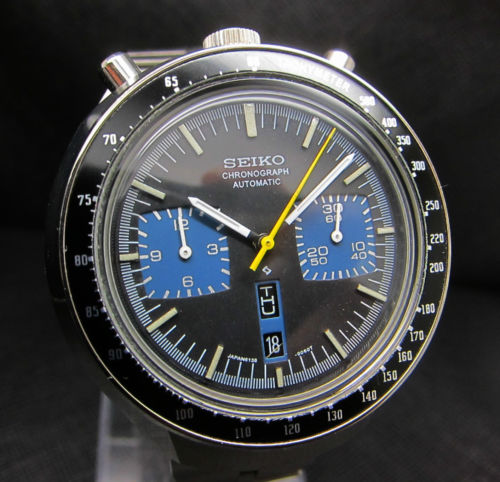
Seiko Automatic 12-Hour "Bullhead" chronograph


Today's watch is the super-cool, super '70s Seiko "Chronograph Automatic, " or "Seiko Bullhead Chronograph" as it's come to be called by collectors. So named because the pusher buttons are at the top of the case (rather than the side) and are reminiscent of a bull's horns, with the crown between the two pushers completing the look of a bull's head.


I've also heard it called the "UFO" due to its flying saucer appearance.


Seiko made this chronograph model from about 1974 to 1979.

Here are the details on this particular specimen: All stainless steel "hidden lug" case with screw back. Case 46mm high by 43.5 mm wide, not including crown, 46mm high, and 15mm thick. The head alone on this watch weighs 3.3 ounces. Few dings on the case, nothing serious. Bezel insert is in excellent condition. Excellent condition original dial, brown with gold colored registers. Excellent original crown and original pusher buttons. Crystal is a replacement, a correct beveled edge glass crystal.

Movement: 21 jewel Caliber 6138 movement winds and sets perfectly, keeps time to within 2 min/day. All chrono functions operate perfectly ... start, stop, and reset. Chrono zeroes up perfectly. Not known when last serviced. Day and date are both quick adjustable by pulling out crown to first "click" and turning clockwise to adjust date, and counter-clockwise to adjust day.


Brand new aftermarket "fishbone" bracelet with signed Seiko deployment clasp. The case serial number of 658296 dates this specimen to May 1976.


The Seiko "Chronograph Automatic" really shook up the market in its day because this 12 hour model sold for quite a bit less money than 12-hour chronographs from such companies as Heuer or Breitling. First models of the Seiko sold for around $145, while a Heuer Autavia retailed for around $230 with a steel bracelet. Seiko's chronograph sold quite well in the states because Seiko had already established a solid reputation. The idea of no running seconds already had a precedent with the Caliber 11/12, made by Dubois Depraz with financial and technical assistance from Heuer, Hamilton/Buren, and Bretling. All of these companies had an interest in this chronograph movement and would eventually come out with chronographs containing the Caliber 11 and its improved version, the Caliber 12.

The Seiko 6138 was quite a mechanical marvel in its time, and I believe matched the technical excellence of not only only the Caliber 11/12, but also the Zenith Caliber 3019, used in its El Primero automatic chronograph. Granted, Seiko had five years to study those movements and learn from them, but take into consideration that Seiko made the movement entirely in house, including escapement and hairspring. The movement is amazingly durable. Even the most cosmetically beat up specimens frequently have working movements!

Today, the Seiko Bullhead is popular among collectors, partially because they provide the biggest bang for the buck for a 12-hour chronograph. But they are going up in price. A few years ago, you could buy them all day long at $250 and under, many complete with the watch's signature "fishbone" bracelet. Now, it's not unusual to find them starting at $350 to $450, and if you find one with an ORIGINAL fishbone bracelet (not aftermarket) you can add another $100 to that price.

Because it sits so high on the wrist, the watch tended to get banged around quite a bit, both on the sides and on the surface of the bezel insert on which is printed all the tachymeter numbers for calculating speed of a moving object. This specimen has a few dings on the case, but the bezel insert is in surprising good shape.

Two color combinations of this model were offered. This one is the brown dial with gold colored registers; the other is a black/blue combination. I'm not aware of one color combo being more desirable than the other.

The crown on this watch can actually be used as a secondary means to wind the movement. Most Seiko automatic utilize the crown only to set the time and calendar functions as needed. They rely solely on the rotation of the rotor to wind the mainspring.

This is one watch that definitely requires a bracelet. A leather band on this watch looks ridiculous in my opinion. The best option for a bracelet is of course the original "fishbone" bracelet that it came with. The bracelet has earned the name among collectors because the thin inner links of the bracelet look like the bones of a fish once it has been filleted. The problem is, original bracelets are nearly impossible to find because they tended to take quite a beating by their original owners. Enter the Chinese, with their amazing ability to duplicate nearly anything, especially once it's learned there is a demand for it! There are a number of sellers on eBay offering aftermarket "fishbone" bracelets, specifically for the Seiko Bullhead that are near-perfect replicas of the originals, right down to the perfect fit between the end pieces and the watch's lugs. The bracelets sell for between $35 and $50. They are generous in size (I'm certain they will fit up to an 8-inch wrist) and, honestly, I have no problem attaching one of these to a Bullhead (as I have with this one) as long as one is honest about disclosing the fact.

I should add that complete Chinese-made fakes of the Seiko Bullhead have appeared on the market. They are fairly obvious to spot. Apart from the fact that most are shipped from China (which should raise a red flag immediately) the aftermarket dials and hands are fairly easy to spot. But just be aware. Here is one such example:


Here are some additional photos of this REAL ONE I have:


The watvh is for sale, and if you'd like to make an offer on it, please contact me by clicking here.

You can see my complete listing of watches for sale here.

Hope you have enjoyed this blog entry!

Sincerely,

Bruce

Friday, June 3, 2016

Rare 1936 Hamilton Taylor with Swivel Lugs

Here's one for you Hamilton lovers! A rare 1936 Hamilton "Taylor":


This specimen has a 14kt yellow gold filled case measuring 40mm long tip to tip, by 21mm wide. Case is in very good condition. Few flea bites on bezel corners but most gold filled on the decorative embellishment is intact.


Back is monogrammed "EJ".


And the case manufacturer on this model was the Stat Watch Case Co. of Ludington, Mich.


Good original dial, some darkening, but still very readable. This is the dial option with the gold applied markers. The other option from Hamilton was black inlaid enamel numerals. Crown appears to be the original, or at least a replacement that is correct to the period.


Glass crystal is most likely a replacement. 17 jewel Grade 980 movement winds smooth and sets perfectly. Keeps time to within 2 min/day, but unknown when last serviced. Serial number of G77186 corresponds to 1935-'36 date of manufacture, so the movement is age-correct to the watch, and I believe the original.


Finished with a new old stock Speidel 16m black leather band.

The "Taylor" model is quite interesting, and was only made for one year in 1936, and then discontinued. A brief notation from company sales reports indicates that that Taylor was "renamed" the Talbot in 1937. However, you can see that the two watches, while similar, are distinct from one another:


Taylor                                        Talbot


The Taylor has decorative embellishments on the bezel along the top and bottom. The Talbot's bezel does not have these embellishments. In addition, the lugs on the Talbot are fixed; they do not swivel. Hamilton likely found out early on that the hinged lugs were problematic, and remedied the situation with the new case design. In any event, the Talbot didn't do much better than the Taylor; it was discontinued after its appearance in the '37 catalog.

There are no factory records indicating how many "Taylors" were made. If not "rare," then at least this model is "unusual," and this is the first one I've ever seen. I would suspect only a fraction of these have survived in the ensuing 81 years because all of Hamilton's hinged lug models (Piping Rock, Pierre, Wilshire, etc.) were known to be fragile and prone to breaking whenever the delicate lugs took a hard knock. Many are the Piping Rock specimens out there with repairs to the lugs!

I think overall, this is a very nice specimen, and the piece is already in the hands of an astute Hamilton collector just a few days after I acquired it. If you ever see one of this, you should probably pick it up!

I would like to thank Dan Keefe for his help on this blog entry. If you don't know about his website (click here) you should check it out. It's one of the best sites I've ever seen for Hamilton watch collectors!

Cheers,

Bruce Shawkey

Monday, May 23, 2016

Rare 1930s Rolex Tudor ... a Wilsdorf Blunder Turned Blockbuster


This entry's little treasure is a Tudor dress watch from the 1930s. Gold filled bezel with "Staybrite" steel back. The case measures 37mm long by 26mm wide. It's powered by the 15 jewel Tudor Caliber 59 movement, built on Fontainmelon's Caliber 30 ebauche.


Impossible, you say. The Tudor watch wasn't invented until 1946, right?

Not so, as it turns out. Before Tiger Woods, before the "Rose" logo, there were the first generation Tudor watches. Not many folks know this, but Rolex registered the brand name "Tudor" way back in 1926, a full 20 years before the Tudor Watch Co. went into business. How do I know this? Because it's right on the Tudor website! (1)

It was kind of crazy time for Rolex back in the '20s ... a decade of prosperity. Company founder Hans Wilsdorf was bulk registering all kinds of brands -- some of them rather crazy -- in an Edisonian effort to get his hands on as many names as possible. In 1920 alone, he registered 18 brand names. Many of them were never used. My personal favorite is LON, which stood for League of Nations!

Then, Wilsdorf happened upon the name Tudor. The story goes it was one of his personal favorites because it paid homage to Britain's Tudor era. (Remember that Wilsdorf, born in Germany, had become a British citizen by this time). Rolex sat on the brand name for several years, but in the 1930s finally decided to do something with it. At least one watch historian (2) believes the brand represented an early version of what Tudor would become when it was launched on a wider scale in 1945 --- a sort of "starter watch" for the budget conscious person who would eventually "move up" to a Rolex. Here's an early version, made for Catanach, a respected jewelry firm in Australia:


Early Tudor, chrome case, quadrant dial. Notice
the signature logo, with the horizontal bar
of the "T" extending over the rest of the letters.
Image from www.tudorwatch.com.

Judging by how few of these we see today, the brand was not a success. Wilsdorf's timing couldn't have been worse, no pun intended. The United States was in the midst of the Great Depression, with the ripple effects being felt worldwide. Fast forward to 1946. It was now the perfect time to relaunch the brand. There was a huge market for watches, caused by pent up demand from World War II. Consumers needed a good watch, but at a good price because the prosperity of the 1950s was still a ways off. Enter Wilsdorf with his "new" Tudor, a starter watch guaranteed by the full faith and resources of Rolex.

But back to our example. The inside case back is signed "Handley," which at first glance appears suspect of a recasing.


However, we know that Rolex exported many of its watches in an unfinished state, to be cased at the country of ultimate sale. This was to save on import duties. Handley (full name J W Handley) was probably Australia's largest casemaker at the time, located in Melbourne. So I believe this is another watch that was exported to Australia like the Catanach mentioned above. I have every reason to believe this watch is in its original state.


With the case having wire lugs, I've attached an 18mm open-ended tan pigskin band to the watch. The watch has just been serviced (April 2016) by my watchmaker. It sets and winds perfectly, and keeps good time for a watch of this vintage. The crystal and crown I'm certain are replacements, but serve their function.


It's difficult to put a price on this watch. It's one of those pieces that's "rare," but as we all know, rarity alone does not determine value if there's not a demand for the watch. This is a watch that is obviously looking for a collector who specializes in early Tudor. I've seen one in a 9kt gold case priced at 875 British pounds, which is $1,268 in U.S. dollars. I believe that's a "wishful thinking" price, and I have a much more modest price in mind for this specimen. It's for sale on my website (click here) for $295.

Cheers, or should I say, g'day.

Bruce

Footnotes:
(1) http://www.tudorwatch.com/magazine/article/tudor-history-origins-1926-to-1949
(2) My source on this is the author at http://www.vintage-watches-collection.com/watch/rolex-watch/rolex-tudor-gold-cushion-very-early-1935/


Saturday, May 14, 2016

Waltham 1917 Trench Watch with Gold Overlay Back

Hello friends and customers.

Another terrific acquisition this week. I was going through some collector's stuff, and spotted this Waltham military watch with yellow engine turned back covering a white metal case:


He sold it to me very reasonably because he thought it was a put-together case! However, I remembered in Stan Czubernat's Waltham book that there was an entire chapter devoted to these cases.

Sure enough, I got it home and it turns out to be an example like the one on page 98 of Stan's book, called the "Cadet." Stan believes that this case was designed by Ezra Fitch himself, then head of the Waltham Watch Co. Fitch was an avid wristwatch proponent and probably as responsible as anyone for bringing the man's wristwatch out of the novelty realm and into the mainstream. He held several case patents and worked closely with Charles Depollier in manufacturing the Waltham/Depollier Waterproof Watch, arguably the finest and today most sought after trench watch model of the Great War.

Anyway, Fitch had some rather eccentric ideas about the caseback of a watch, notably that a back made of gold (or at least the application of a gold layer) would better disperse the body heat of the wearer and thus protect the watch's movement from excessive heat. Experience has shown us that this concept is rather silly, but Fitch believed it fervently, and thus designed this case. To this day, we do not know who manufactured the case for Waltham, but it is 100 percent legitimate to this "Cadet" model, and the inside of the case back is stamped:


"WALTHAM
14KT GOLD ON
WHITE METAL"

and then the number 22432 is stamped below this, which I assume is a case serial number.


Upon further examination, we find that the movement's serial number of 20,955,090 is a 3/0-size Grade 361 movement with 7 jewels, manufactured in year 1917. This serial number definitely puts the watch in the range of the Great War. Whether it saw actual service or not is anyone's guess. Its wonderful condition suggests that it did not see service, but you never know. The watch runs in its current state, and even keeps respectable time, though I have no idea when it was last serviced.


The black dial with luminous numerals I thinks adds further value to the watch, since most of these I've seen have white dials. The dark condition of the luminous and the fact that a good portion of it is missing suggests to me that this is an original dial, and I for one would not have this dial refinished in a million years!


The crown I believe is also original.


Finding this watch is a great example of how having a little upper hand on knowledge can pay huge dividends when you're out searching for watches. I have never quite understood the reluctance of so many watch collectors to acquire reference books. They view it as an expense when in reality it is an investment that often times pays for itself many times over. The other nice thing about this watch is that it was obtained from an estate. Don't get me wrong; I love buying watches from other watch dealers. But some of the finest, most original-state watches I've acquired over the years are what I call "organic" watches. These are watches that have the least likely chance of being "molested" or "messed with." Like the "field-to-consumer" organic fruits and veggies, these watches haven't passed through multiple middlemen where all manner of molestation can occur ... re-casing, swapping dials/movements, etc. I am 99% sure that this watch is all original. Quite a feat for a timepiece nearly a century old! 

Stan's book places a value on this model of between $900 and $1,000. But keep in mind that is for a watch in fully restored condition, with the movement completely torn down, cleaned/oiled, and re-assembled. I conservatively believe the black dial would add another $100 to $200 to that figure.

This specimen is for sale on my website, and can be found here, until it sells of course!

Happy collecting!

Bruce